It is 2:47 a.m., and the analyst has not slept in nineteen hours.
On her screen, a ransomware operator is moving laterally through a regional hospital network. Endpoint logs are scrolling faster than any human can read them. Firewall events, cloud audit trails, Kerberos tickets, privileged-account anomalies, the raw exhaust of a breach in progress. Somewhere in that torrent is the answer: the patient-zero host, the compromised credential, the misconfigured trust relationship that let the intruder in. She has minutes, not hours.
So she does what tens of thousands of analysts now do reflexively. She selects several thousand lines of telemetry, copies them, and pastes them into the AI assistant her vendor bolted onto the platform last quarter. Summarize the attack path. Identify the initial access vector. Prioritize containment steps.
The model responds in four seconds. It is articulate, confident, and largely correct. The analyst exhales.
But pause on that moment, because it contains a question the entire industry has been racing past: where did the data go?
That telemetry, the host names, the internal IP ranges, the service-account naming conventions, the cloud bucket paths, the timestamps that quietly reveal when the security team sleeps, left the hospital's perimeter the instant she hit enter. It traveled to a general-purpose model hosted by a third party, processed in an environment the hospital does not own, cannot audit in real time, and does not fully control. In the span of one keystroke, an organization's most sensitive operational intelligence became someone else's inference workload.
This is not a hypothetical reflex. A 2025 study of enterprise AI usage found that 45 percent of enterprise employees now use generative AI tools, and that 77 percent of those users paste data directly into the chatbot. Roughly a fifth of those pastes contain regulated personal or payment data, and 82 percent originate from unmanaged personal accounts the organization cannot see. This is not a story about a single careless analyst. It is a story about an architectural decision that thousands of enterprises have made almost by accident, and the blind spot it is opening up across the defensive landscape.
01. The Great Outsourcing of Judgment
How rented intelligence became the industry default
The speed at which generative AI colonized the security operations center has few precedents in enterprise technology. In roughly eighteen months, "AI-powered" went from a differentiator to table stakes. SIEMs, SOARs, XDRs, EDRs, threat-hunting suites, and vulnerability platforms all sprouted natural-language copilots, summarizers, and ask-your-data interfaces. The pitch was irresistible to budget-holders drowning in alert fatigue: let the machine read the logs, triage the noise, and explain the threat in plain English.
The money followed the pitch. Analysts at Grand View Research size the AI-in-cybersecurity market at roughly 25 billion dollars in 2024, rising toward 94 billion dollars by 2030 at a compound annual growth rate near 24 percent. The appetite is real. The question is what enterprises are actually buying.
What the marketing rarely disclosed was the architecture underneath. In the overwhelming majority of cases, the AI was not built. It was rented. A vendor wired an API call to OpenAI, Anthropic's Claude, Google's Gemini, or another frontier foundation model, wrapped it in a SOC-themed interface, and shipped it. The intelligence was real, but it was generic, a brilliant generalist asked to moonlight as a security specialist.
To be clear, these foundation models are extraordinary. They are among the most capable reasoning systems humanity has produced. But capability and fitness for purpose are different properties, and the distinction matters enormously here. Frontier models are optimized to be excellent at almost everything, to draft a sonnet, debug Python, explain tax law, and summarize a board deck with roughly equal grace. That breadth is precisely the point of a foundation model. It is also precisely why it is the wrong default for a domain where context, confidentiality, and consequence are everything.
The industry, in its rush, conflated two things: adding AI and adding security intelligence. They are not the same. Bolting a general-purpose reasoning engine onto a security workflow gives you fluent narration of your environment. It does not give you a system that was designed, from first principles, to defend it. And in the gap between those two things lives the risk.
Market research estimates cited in this article.
02. The Data You Can Never Take Back
Why security telemetry is the worst data to externalize
To understand why this matters, you have to appreciate what security telemetry actually is.
Most enterprise data is a record of the business: invoices, emails, customer records, product specs. Security data is something stranger and more dangerous. It is a map of the organization's nervous system and, simultaneously, a map of its wounds.
Security logs and endpoint telemetry reveal the exact composition of the environment, the operating systems, patch levels, installed agents, and the rhythms of normal activity. Threat intelligence and active incident data expose not just what adversaries are doing, but what the defenders know and, by omission, what they have missed. Identity and access events lay bare the human topology of power inside the company: who the administrators are, which accounts are over-privileged, where the trust boundaries bend. Network architecture, cloud configurations, attack-path data, and vulnerability findings together constitute something close to a blueprint for compromise. And the investigation notes, the analyst's working hypotheses, the half-formed theories, are arguably the single most sensitive artifact of all, because they reveal the defender's mind.
This is not ordinary corporate data. It is the master key drawn as a diagram.
The cost of mishandling it is now well quantified. The 2025 annual study of breach costs, built on 600 breached organizations, put the global average breach at 4.44 million dollars and the United States average at a record 10.22 million dollars, with healthcare the most expensive sector at 7.42 million dollars.
To send this data outside the organization's control is to make a series of consequential bets at once. There is the sovereignty bet, whether you can tolerate your most sensitive operational data being processed in jurisdictions and infrastructures you do not govern. There is the regulatory bet, whether that movement is compatible with GDPR, HIPAA, sector-specific mandates, and the rising tide of data-residency laws, particularly when the data crosses borders en route to an inference endpoint. There is the third-party dependency bet, the quiet expansion of your attack surface to include the security, retention practices, and incident history of every external model provider in your chain. And there is the subtlest bet of all: the slow erosion of control over your own security intelligence. Each query teaches an external system a little more about how you defend yourself.
This is no longer a theoretical concern. The same research found that one in five breaches now involves "shadow AI," the unsanctioned use of AI tools by employees, and that those incidents added roughly 670,000 dollars to the average breach. More striking still, 97 percent of organizations that suffered an AI-related breach lacked basic AI access controls, and 63 percent had no AI governance policy at all.
- 1 in 5 breaches now involve shadow AI, the unsanctioned use of AI tools. (Industry research, 2025)
- 97% of AI-related breaches occurred where proper access controls were missing. (Industry research, 2025)
- +$670K added to the average breach where shadow AI usage was high. (Industry research, 2025)
None of this requires malice on the vendor's part to become a problem. It requires only that the architecture sends data where the enterprise cannot follow it. The uncomfortable truth is that you cannot un-send a prompt. Once your attack-path data has been transmitted, the question of who saw it is no longer entirely yours to answer.
03. The Comfortable Fiction of Masking
Why stripping the labels does not strip the intelligence
Confronted with these concerns, the industry reached for a familiar comfort: we will just mask the data first. Strip the host names, tokenize the IPs, redact the user identities, and the sensitive context disappears before it ever leaves the building. Problem solved.
It is a comforting story. It is also, in the contexts that matter most, a fiction, and any seasoned threat hunter understands why.
Security data derives its meaning from relationships, not from individual fields. You can replace dc01.corp.internal with HOST_A and 10.0.0.5 with IP_1, but the moment you preserve the relationships between them, who authenticated to what, in which order, from where, you have preserved the very thing an adversary or an external system would want. The structure is the intelligence. Masking the labels while keeping the graph is like blacking out the names on a battle map but leaving every troop movement intact.
The academic record on re-identification is sobering. In a landmark 2019 study in Nature Communications, Rocher, Hendrickx, and de Montjoye showed that 99.98 percent of users could be correctly re-identified in any "anonymized" dataset using just 15 demographic attributes. An earlier study by the same lab found that four time-and-place data points were enough to uniquely identify 95 percent of individuals in a mobility dataset. If that is true of consumer data, it is far more true of security telemetry, which is unusually rich in distinctive patterns.
This is the heart of context-reconstruction risk. A sufficiently capable model, fed enough masked-but-relational data, can infer an astonishing amount: the rough scale of the environment, the operating cadence of the security team, the technology stack, the likely cloud provider, even the industry vertical. Metadata leaks where field-level redaction cannot reach. The timing of events fingerprints work schedules and automation. The shape of an attack chain reveals which controls exist and which are absent. Behavioral patterns identify privileged users by their rhythms even when their names are gone. Infrastructure fingerprints, port combinations, service banners, naming conventions even after the specific names are stripped, narrow the field dramatically.
The honest conclusion is not that masking is worthless. It raises the cost of casual exposure. But it is not a substitute for control. It manages a symptom. It does not address the underlying architectural decision to externalize the data in the first place. Independent telemetry underscores the point: an analysis of 22.4 million enterprise AI prompts found that 2.6 percent contained company-sensitive data, with source code the single largest exposure category at 30 percent.
04. Fluent, But Foreign
Why a generalist sounds like a specialist without being one
Set the data question aside for a moment and ask a narrower one: even when a generic model is used responsibly, is it actually good at cybersecurity?
The answer is more nuanced than either the boosters or the skeptics admit. General-purpose models are genuinely useful for explanation, summarization, and surfacing well-documented techniques. But cybersecurity is not general-purpose question-answering, and the differences expose real limitations.
A foundation model has read about attack chains; it has not lived inside thousands of them as continuous, causally-linked sequences. It can describe lateral movement eloquently while struggling to reason about this environment's specific lateral-movement path, because it has no durable model of this environment. It lacks persistent security memory: every conversation begins, in effect, as a stranger walking into the building for the first time. It does not know that the anomalous service account flagged today is the same one that triggered a false positive last quarter, because it was never there last quarter. It has no native sense of which of your assets are crown jewels and which are disposable, so its threat prioritization drifts toward the generically plausible rather than the organizationally critical.
Then there is the hallucination problem, which is merely an inconvenience in most domains and a liability in this one. A model that confidently invents a plausible-sounding indicator of compromise, misattributes a technique, or fabricates a remediation step does not just produce a wrong answer. It can send an exhausted analyst down a false path during the minutes that matter, or worse, generate misplaced confidence that a threat is contained when it is not. Inconsistent reasoning across sessions compounds the problem: ask the same triage question two ways and you may get two prioritizations.
What this reveals is that effective cyber defense rests on capabilities a general model structurally lacks. It requires context, a working understanding of the specific environment being defended. It requires memory, continuity across incidents, so that today's anomaly is read against the organization's own history. It requires native fluency in threat intelligence and attack-chain logic, not as recalled trivia but as operational reasoning. And it requires environment-specific judgment, the ability to weight a finding by what it means here, in this business, with these assets. A generalist can sound like all of this. Sounding like it and being it are not the same, and in a discipline where the cost of error is measured in dwell time and breach impact, the difference is decisive.
05. The Vertical Turn
From one model for everything to many models for something
If this critique sounds familiar, it is because the broader AI market has already begun to learn the lesson, just not yet in security at scale.
The first wave of enterprise AI adoption was horizontal: one giant model for everything. The second wave, now gathering force, is vertical. Organizations are discovering that domains with dense, specialized, high-consequence knowledge are poorly served by a generalist, however brilliant, and far better served by models grounded in the language, data, and reasoning patterns of a specific field.
In healthcare, clinical models trained on medical literature and coding systems outperform general models at the tasks that actually matter, and, crucially, can be deployed within compliance and privacy boundaries that an external API cannot satisfy. In finance, domain-tuned systems for risk, fraud, and regulatory analysis handle the field's particular vocabulary and its zero-tolerance for confident error far better than a generalist. In law, models grounded in case law and contract structure reason with a precision that generic systems approximate but do not match, and where, again, confidentiality is not a feature but a precondition.
The pattern across all of these is identical: the more sensitive the data, the more specialized the reasoning, and the higher the cost of error, the stronger the case for vertical AI over a borrowed general brain. The market is beginning to price this in. Mordor Intelligence projects the cybersecurity agentic-AI segment alone to grow from 1.83 billion dollars in 2025 to 7.84 billion dollars by 2030, a 34 percent compound annual growth rate, as enterprises move beyond rule-based tools toward systems that reason within a defined domain.
Measured against that pattern, cybersecurity is not merely a candidate for vertical AI. It is arguably the strongest candidate of all. Few domains combine such extreme data sensitivity, such specialized reasoning, and such severe consequences for being wrong. The discipline that exists to protect everything else has, ironically, been among the slowest to demand AI built specifically to protect it. That is beginning to change.
06. Engineering a Different Answer
A model built to defend, not to describe
Some organizations saw this coming and made a different bet, not a marketing bet, but an architectural one.
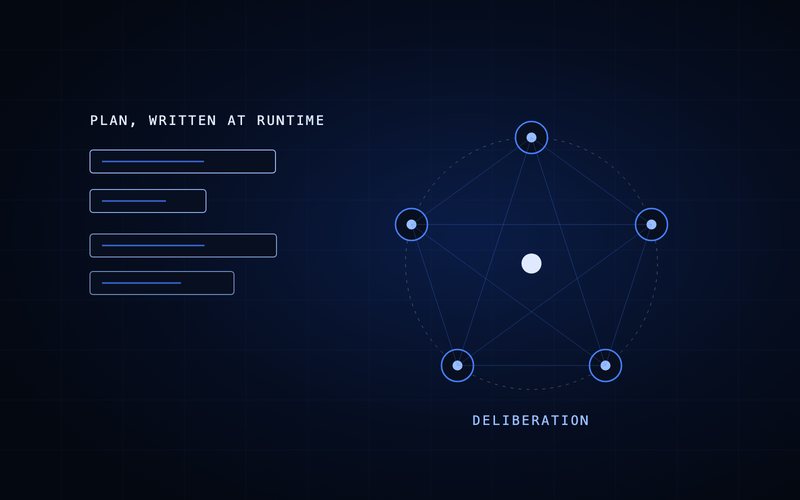
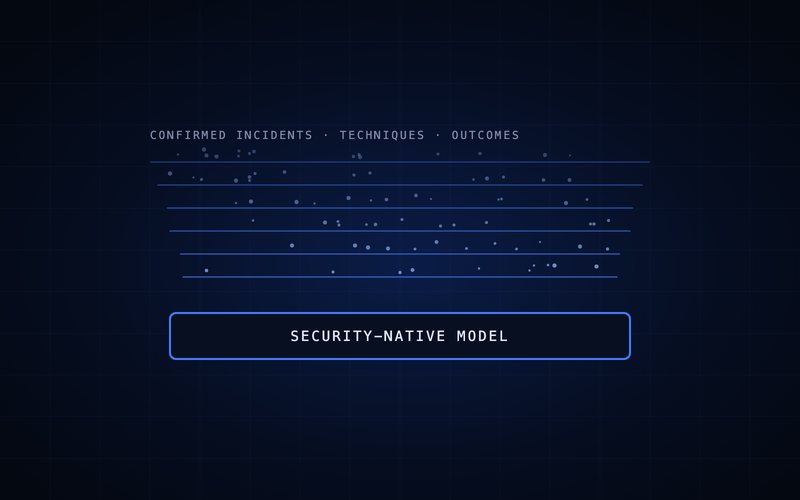
Spharaka Networks™ is among the companies that declined to take the path of least resistance. Rather than wrapping an interface around a rented foundation model and calling it cybersecurity AI, it made the harder engineering decision to build a cybersecurity-native model from the ground up, a system whose purpose, from its first line of training data, was to reason about defense rather than to reason about everything. This is the SAGE™ AI Model, Spharaka's proprietary Cybersecurity SLM developed by fine-tuning state-of-the-art open foundation models using Spharaka's proprietary cybersecurity datasets, reasoning frameworks, and autonomous investigation technology.
The distinction is not cosmetic. A model's character is shaped by what it learns from. A general model learns from the open internet, a vast, brilliant, but undifferentiated corpus. SAGE™ was instead grounded in the substance of the discipline itself: intelligence distilled from more than 16 million security events, the accumulated patterns of real attacks, real investigations, and real responses. The aim was not to teach a model to talk about security, but to instill the operational reasoning that experienced defenders develop over careers, an internalized sense of how attacks unfold, how investigations branch, how detections should be engineered, how hunts should be framed, and how a SOC actually works under pressure.
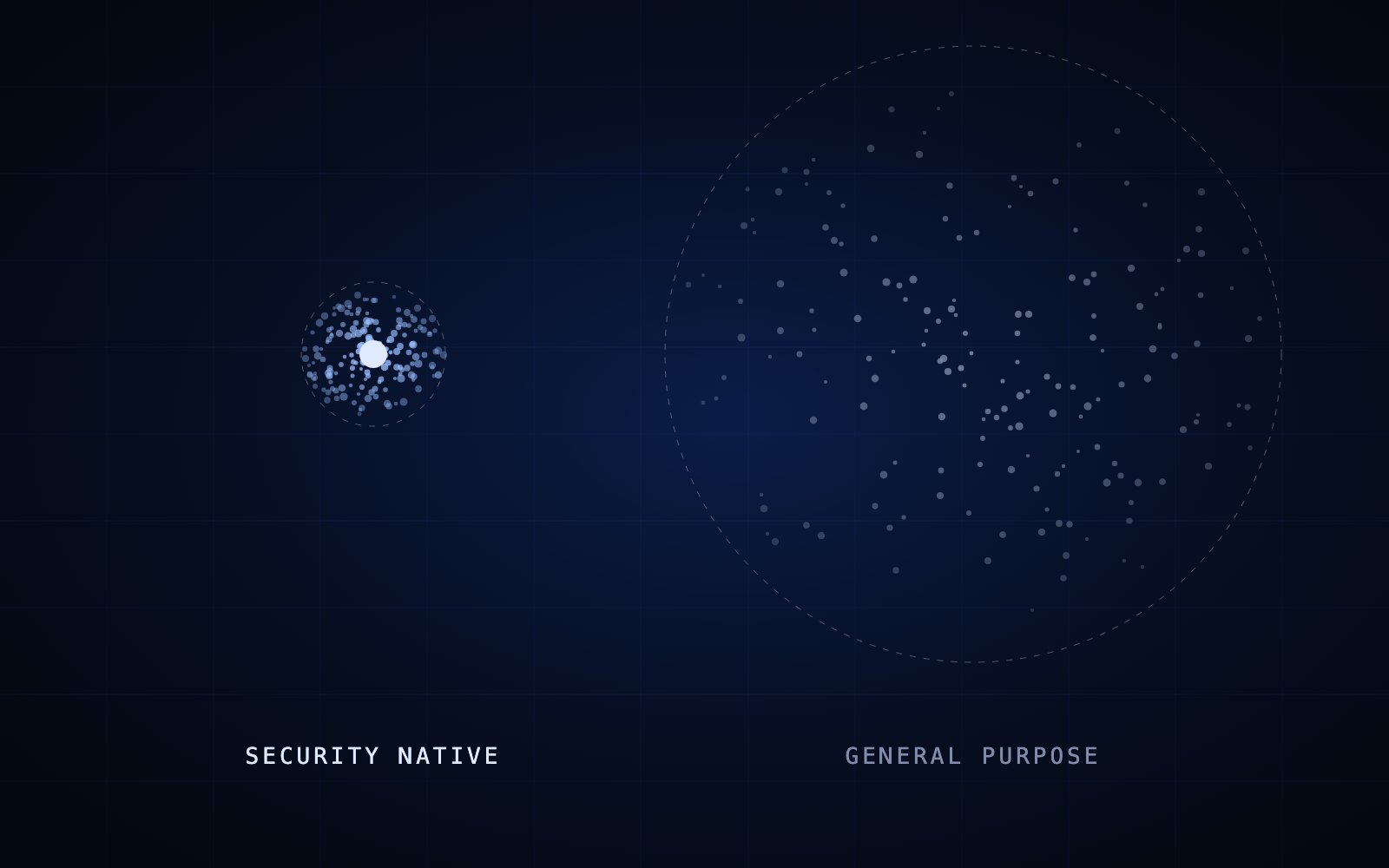
The argument for this approach is not that frontier models are bad. It is that fitness for purpose in a high-stakes, high-confidentiality domain is worth engineering for deliberately rather than approximating by accident. Vertical specialization, in this framing, is not a smaller version of general intelligence. It is a different kind of intelligence, narrower in scope, deeper in domain, and far better matched to the realities of defending an enterprise.
07. A Brain Per Customer
Dedicated intelligence and the sovereignty question
The second decision is, if anything, more consequential than the first, and it speaks directly to the sovereignty problem at the heart of this investigation.
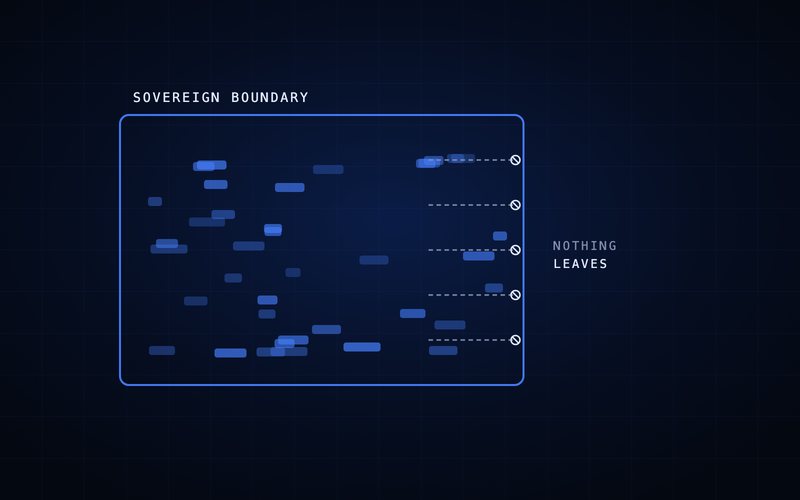
The default posture of generic-AI security tooling is shared intelligence: one model, serving many customers, with all the data-commingling and control questions that implies. Spharaka Sphere™ is architected around the opposite premise, a dedicated cyber-intelligence layer for each customer, with knowledge boundaries that do not bleed across organizations.
In practical terms, the design centers on a few principles. Each customer's AI operates within its own context and its own retrieval architecture, so the system reasons over that organization's data without folding it into a shared pool. Each develops its own organization-specific security memory, a persistent, accumulating understanding of that environment's assets, baselines, history, and idiosyncrasies. There is no cross-customer intelligence leakage by design, because the boundaries are structural rather than promised. And data residency and sovereignty are treated as architectural requirements rather than after-the-fact compliance checkboxes. The data stays where the enterprise needs it to stay. The platform's extended detection and response layer, AuraXP™, operates inside this same boundary, so the analytical horsepower applied to an organization's telemetry stays within its perimeter of control rather than reaching out to an external generalist.
There is a useful analogy for what this buys an enterprise. Sending your incident data to a generic external model is like calling in a brilliant consultant who has never seen your environment, one who arrives, reasons impressively from first principles, and leaves, taking what they learned with them and remembering nothing of you for next time. A dedicated, environment-specific intelligence layer is closer to hiring a security analyst who has worked inside your organization for years: who knows that the odd traffic from the finance subnet is a legacy integration and not an intrusion, who recognizes a returning adversary by their habits, and whose understanding of your environment compounds rather than resetting with every engagement.
Both can be intelligent. Only one of them actually knows you. And in a discipline where context is the difference between catching an intrusion and waving it through, knowing you is not a luxury feature. It is the entire point.
08. The Coming Divergence
Where serious defense goes next
So where does this leave the CISO weighing her options, the security architect drawing the next reference design, the MSSP deciding what to build its practice on?
It leaves them at a fork that will define the next several years of the discipline. The first era of AI in security was about access, getting a powerful model into the workflow at all. The era now beginning is about fit, and the two are not the same race.
The future of cybersecurity AI will not belong to the largest generic models, impressive as they are. It will belong to systems defined by a different set of properties. Context-aware intelligence that understands the specific environment it defends. Security-native reasoning built for the domain rather than borrowed from it. Sovereign architectures that keep the most sensitive data under the enterprise's own control. Organization-specific memory that compounds over time. And purpose-built cyber-reasoning systems designed, from the first principle, to defend rather than merely to describe.
The generic foundation models will remain extraordinary, and they will retain an important role. But the gravitational center of serious enterprise defense will shift toward the vertical, the dedicated, and the sovereign, for the same reasons it has already begun shifting in medicine, finance, and law, only more urgently, because the data at stake here is the data that protects everything else.
The analyst at 2:47 a.m. will still need her four-second answer. The question facing every enterprise is simply where that answer comes from, what it knows, and what it costs to obtain it.
The question is no longer whether AI will transform cybersecurity. The question is whether enterprises will trust generic intelligence with their most sensitive security data, or demand AI that was built specifically to defend it.
About the Author
Vishnu Nair is a Founding Member and Director of Growth and Partnerships at Spharaka Networks™.
Disclosure: This article reflects publicly available information, industry research, and independent analysis as of June 2026. Grand View Research, Mordor Intelligence, and other product, company, or service names referenced are trademarks of their respective owners. Spharaka Networks™, Spharaka Sphere™, AuraXP™, SAGE™, and related marks are trademarks of Spharaka Networks Private Limited.
Cybersecurity-Native AI, Built to Defend
Spharaka Sphere™, powered by the SAGE™ AI Model and AuraXP™, delivers a dedicated cyber-intelligence layer for each customer, sovereign by design, purpose-built for autonomous defense.