Nothing was forged
The exchange's own statement, published at 02:23 UTC on 30 October, puts the estimated total impact at around 6.3 billion dollars and says that roughly 3 billion of it had been frozen on-chain at the time of writing. The on-chain analysis published separately that morning put the amount taken at about 6.36 billion dollars, valued at what each asset was worth when it moved. Either way it is the largest theft in the history of the asset class, roughly four times the size of the exchange theft of February 2025 that held the record until now.
What makes it worth reading as a security practitioner is not the size. It is that the usual explanations do not apply. There was no ransomware, no encryption, no zero-day in a wallet contract and, on the exchange's account, no leaked private key. The transactions that drained the wallets were signed by the wallets that owned the funds. They were valid. Every node that verified them was right to verify them.
The company has been careful about how it characterises the cause, and the carefulness is worth preserving rather than flattening. Its statement says the initial investigation suggests the incident may involve a compromised DevOps engineer's laptop, which allowed an attacker to gain access to a service container and submit unauthorised withdrawal transactions. Those are hedged words, deliberately. The company has said it will publish a technical post-mortem once the investigation is complete, and it has not published a root cause yet.
Characterisation as published by the exchange on 30 October 2026, including its statement that no private key leak was found.
The company's own account, and what it leaves open
Two sentences from the exchange do most of the work. The first is the one above: a suspected compromised engineer laptop, access to a service container, unauthorised withdrawal transactions. The second came from its co-chief executive, Richard Teng, who addressed the obvious follow-up question directly.
"To be clear: the attacker did not simply use one engineer's permissions, and this was not a single 'one-click' action," he said. "It involved a more complex attack process." He added that the investigation had not attributed responsibility to any individual.
That is an unusually useful clarification, because it closes off the comfortable reading. The comfortable reading is that one over-privileged engineer existed, and that the lesson is to review entitlements. The company is saying that is not what happened. Something stood between a compromised workstation and the authority to move funds on ten chains, and whatever that something was, it was traversed. Until the post-mortem lands, how it was traversed is the open question in this incident, and nobody outside the company can answer it.
Thirty-six hours of patience
The published on-chain analysis dates the start of the operation to the morning of 28 October, when the wallet that would go on to drive the attack received three small withdrawals from a mixing service. That is at least 36 hours before anything of value moved.
Early on 29 October the operator deployed a first version of the attack code and tested it against two wallets. Later the same day it rehearsed the final version on a third wallet and routed the test funds back to itself. Four hours after that rehearsal, the same code was installed on an exchange hot wallet.
Read that sequence as a defender and the thing to notice is how much of it is observable. A rehearsal happened. Code was deployed, tested, revised and tested again against live wallets, with the proceeds returned so that nothing would show up as a loss. For a day and a half there was activity in the environment that was not a theft and was not normal either, and it was the cheapest possible moment to find.
Times UTC, as set out in the published on-chain analysis of 30 October 2026.
A documented feature, used exactly as documented
The Ethereum leg of the attack used EIP-7702, an account abstraction mechanism introduced in the Pectra upgrade in May 2025. It lets an ordinary wallet hand control of its own behaviour to a smart contract by signing an authorisation, and the arrangement stays in place until the wallet signs a new one.
The attacker had the exchange's hot wallet sign an authorisation pointing at a sweeper contract that accepts instructions only from the operator. From that moment the wallet was no longer a plain account that moves funds when its owner says so. It was an account that does what the sweeper tells it, and the sweeper took instructions from one address.
There is no vulnerability in that paragraph. The feature is public, specified and behaving correctly. What it changes is the meaning of a single signature. A conventional transfer signature spends once and expires. A delegation signature does not spend anything at all, which is exactly why it is easy to treat as harmless, and it persists. The analysis notes that funds arriving in the wallet after the first sweep were swept again, repeatedly, through the evening, because the delegation was still in force.
Fifty signatures for a moving target
One detail in this attack is worth understanding properly, because it is the part that leaves a usable fingerprint.
Every wallet keeps a running count of the transactions it has sent, called a nonce, and an authorisation is valid only at the count the wallet has reached at the moment it executes. An exchange hot wallet is the worst possible target for this constraint, because it is processing customer withdrawals continuously and its count never stops moving. Sign one authorisation and by the time it reaches the chain the wallet has moved past it.
The attacker solved this by not guessing. A single transaction carried 50 authorisations, each signed by the hot wallet, each valid at a different consecutive count, prepared in advance as one batch. One of them matched when the transaction executed, which was all that was needed.
That batch is the most defensible thing in the whole incident. No legitimate operation asks a treasury wallet to authorise the same delegation across fifty consecutive positions. It is a request whose shape has no benign explanation, and it was made by a system that could have been asked to refuse it.
Mechanism and count as described in the published on-chain analysis.
Four minutes
The execution bears no relation to the preparation in pace. Between 20:05 and 20:09 UTC, five XRP Ledger wallets sent 233.46 million XRP to a single attacker address, each one left holding nothing but its minimum balance. Shortly after 20:10, wallets on Solana and Optimism followed.
At 20:20 the Bitcoin hot wallet sent 18,270 BTC to an attacker address and, inside the same block, began breaking it into round 1,000 and 100 piece amounts, a splitting pattern used to make later tracing expensive. At 20:20 the transaction carrying the fifty authorisations was submitted. Within two minutes of the Bitcoin transfer a Tron hot wallet sent 612.7 million USDT and 46.4 million TRX.
Three minutes and 24 seconds after the delegation landed, the operator instructed the hot wallet to send its entire balance. That single transaction moved 167,464 ETH and 63 tokens, including 1.615 billion USDT. Further sweeps of the same wallet followed at 20:41, 20:59, 21:04, 21:44, 22:39 and 23:56, and a second wave reached wallets on two more chains at 23:05.
The whole of the main event fits inside the interval that a well-run security operation spends deciding whether an alert is worth opening.
Times UTC on 29 October 2026, as set out in the published on-chain analysis.
Ten chains, one window, and an explanation that does not fit
The early theory, when the first transactions appeared, was that the authorisations had been obtained by phishing. The analysis points out the problem with that: phishing a signature covers the Ethereum leg and leaves everything else unexplained.
Only the Ethereum wallet used the delegation. The XRP Ledger wallets, the Bitcoin hot wallet, the Tron hot wallet and the Solana, Arbitrum, Avalanche, Optimism, Base and Polygon wallets all moved their funds by ordinary signed transfers. A second Ethereum hot wallet sent 28,006 ETH, 55.7 million USDT and 25.9 million RLUSD the same way, with no delegation involved at all.
These are different chains with different key types and different signing schemes, and all of them produced valid signatures for the attacker inside about half an hour. The assessment in the published analysis is that this points to a compromise of the exchange's hot wallet signing infrastructure, and that the most likely explanation is that the attacker gained the ability to make that signing system sign transactions of its choosing across chains. The batch of fifty suggests the access may have been time limited, or that signatures had to be requested through a system rather than taken freely.
This is the part that generalises furthest beyond cryptocurrency, and it is worth stating plainly. The blast radius was not a wallet or a chain. It was everything one signing service would sign.
- Ethereum
- About 3.79 billion dollars, including 200,630 ETH and 185 other tokens
- Bitcoin
- 18,270 BTC, about 1.47 billion dollars
- Tron
- 612.7 million USDT and 46.4 million TRX, about 628 million dollars
- XRP Ledger
- 233.46 million XRP, about 296 million dollars
- Solana
- 970,500 SOL, about 96 million dollars
- Four more chains
- Arbitrum, Optimism, Base, Avalanche and Polygon, about 77 million dollars in total
Valuations at the time each asset was taken, from the published on-chain analysis.
The response ran at a different speed
What happened next was fast by the standards of incident response and slow by the standards of the attack. The first freeze landed at 21:01, when the issuer of the largest dollar stablecoin froze 971.1 million of its tokens, 37 minutes after the main sweep. A second issuer froze 823 million of its own, in coordination with law enforcement, at 21:04.
Between 21:42 and 22:01 one attacker wallet sold 48 million of a third stablecoin on decentralised exchanges before its issuer froze the 40.5 million that remained at 22:01. A fourth issuer froze 27.8 million at 22:10 and more at 22:26. At 23:35 the verified total frozen reached 2.54 billion dollars. At 00:08 on 30 October the security council of one chain used its powers to force two transfers out of the attacker's wallet there, moving 8,426 ETH and 74.6 million ARB back out of reach.
By the 00:30 cut-off of the published analysis, about 2.7 billion dollars had been frozen and the attacker still controlled about 2.4 billion, including more than 420,000 ETH and 18,270 BTC, in assets that no issuer can freeze. The exchange's own statement a couple of hours later put the frozen figure near 3 billion. Both numbers are moving, and neither is final.
The asymmetry is the lesson, not the arithmetic. The theft took minutes and reached everything. The recovery took hours, required four separate companies and a governance body to act, and reached a little under half.
Exchange statement of 30 October 2026 and the on-chain analysis cut off at 00:30 UTC the same day.
The laundering had already started
One detail says more about the operation's priorities than any statement will. Before the freezes landed, about 325 million dollars of stablecoin was sold through intent based contracts to professional market makers for roughly 122,300 ETH. The implied price was near 2,650 dollars per ETH at a time when ETH was trading around 2,300 to 2,350: a discount of more than ten per cent, paid voluntarily.
A second wallet supplied 60 million to a lending protocol and borrowed about 19,760 ETH against it, and the protocol froze the affected markets. On Tron, 300 million moved to a wallet supplying a lending platform and a further 200 million went through intermediate wallets and was swapped.
Paying a ten per cent premium to convert a freezable asset into an unfreezable one is a rational trade when you expect the freeze within the hour, and it tells you the attacker had modelled the defensive response in advance. They were not surprised by the freezes. They had priced them.
Attribution, and how firmly to hold it
The published on-chain analysis attributed the theft, with high confidence, to a state sponsored group operating on behalf of North Korea, on the basis of on-chain and off-chain intelligence and the specific similarities to two earlier thefts: small mixing service withdrawals funding an operator wallet, staging that began well before the theft, and signatures obtained in advance and then executed in a single burst.
On 31 October that judgement became an official finding. The FBI stated that it had determined North Korea was responsible, naming the same unit that it had previously named for the 1.5 billion dollar exchange theft of February 2025. It added that the stolen assets were being converted primarily into Ethereum, and that it expected the operators to move on to further laundering stages.
That is a meaningful change in standing, and it is worth being precise about what it does and does not settle. A government attribution names the actor. It does not explain the mechanism, and the FBI statement did not describe how the signing authority was obtained. Knowing who did it tells a defender almost nothing they can act on; knowing how they did it is the part still missing.
For defenders the tradecraft remains the usable part, and it is specific, repeated and now documented three times: obtain signing authority quietly, rehearse, pre-position the authorisations, and spend them all at once. The laundering has differed from the earlier pattern, which leant heavily on cross-chain bridges, in favour of large swaps through market makers and lending protocols.
The week after, and the question still open
An exchange losing six billion dollars is a solvency question before it is a security one, and the week that followed answered that part fast. The exchange said it had set aside more than 6.34 billion dollars of company money, and its coverage of the stolen balances moved from about 80 per cent to about 90 by 31 October and about 95 by 1 November. Ten named tokens, the ones holding most of the value, were reported fully backed. The outstanding portion is the long tail: tokens thin enough on the market that buying them back at size moves the price.
The money came from three places: part of the user protection fund, part of the futures insurance fund, and the corporate treasury. That is worth noting because it is the arrangement working as intended. An insurance fund that is never drawn on is a marketing line, and this one was drawn on.
Withdrawals reopened on 1 November in a phased rollout, the first phase covering fifteen networks, with a second phase on 3 November. On the first day back the exchange reported 4.65 billion dollars out against 1.01 billion in: a net outflow of 3.64 billion, which it put at 2.1 per cent of its total assets. Read either way you like. A tenth of the customer base did not leave, and a 3.64 billion dollar day is still a bank run that the balance sheet absorbed.
The most substantive step was the least discussed. A new reserves snapshot was taken on 31 October and its zero knowledge proof completed two days later, which means a customer holding one of those ten tokens can check the backing themselves rather than take the assurance on trust. When this article was first published, the replenishment was a promise made on day one. It is now a promise with an independently checkable proof attached, and those are different things.
What has not arrived is the explanation. The exchange has published six recovery updates and no root cause. The post-incident report is still described as something that will follow once the investigation is complete, and a week on, the question of how a compromised laptop became signing authority across ten chains has no public answer.
Exchange recovery updates of 31 October to 3 November 2026, and the attribution reported on 31 October.
What a detection would have had to notice
It is easy to write a list of controls after the fact and harder to be honest about which of them would have fired. So it is worth being precise about what was actually observable, and what reading it would have required.
Nothing on that list is a signature match, and none of those facts is damning on its own. Engineers reach internal services. Treasury wallets receive authorisation requests. Small transfers happen constantly. Each of the five is a line in a log that a reasonable analyst would close.
What is not reasonable to close is the conjunction: a workstation reaching a signing service, a delegation appearing on a wallet that should never carry code, an authorisation covering a range of positions no workflow needs, and valid signatures emerging from independent systems on nine other chains inside the same half hour. That statement is detectable. The five statements underneath it are not, which is the same structural problem that cloud control plane intrusions have, and it has the same answer.
- Contract code attached to a treasury wallet that is meant to be a plain account.
- An authorisation request spanning many consecutive transaction counts, which no legitimate workflow needs.
- An engineering endpoint with a path to the service container that signs withdrawals.
- Independent signing systems, on different chains and different key types, all producing valid signatures inside one window.
- Small test movements that return to their origin, a day before anything of value moves.
This is not a cryptocurrency story
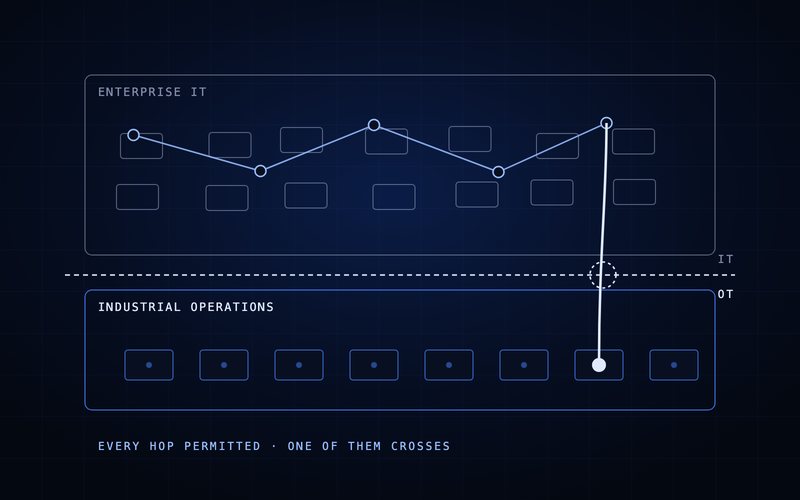
Strip out the chains and the tokens and the shape of this intrusion is ordinary. An attacker obtained the ability to make a trusted system issue valid credentials, collected more of them than any single operation needed, held them, and spent them all in one burst at a moment of their choosing.
An enterprise has several systems that fit that description. A certificate authority issues trust. A code signing service converts an artefact into something every machine in the estate will execute. An identity provider mints tokens that outlive the session that requested them. A privileged access system hands out credentials that work for a window. In each case the thing worth stealing is not the data behind the system, it is the authority the system confers, and in each case an attacker who holds that authority produces activity that is, by construction, correctly authorised.
That is why detection in this category cannot rest on whether an action was permitted. Every action here was permitted. It rests on who asked, how many times, in what order, across how many systems that have no reason to move together, and how far that pattern sits from how that identity has behaved before.
The second constraint is the clock. Three minutes and 24 seconds separated the delegation from the sweep. Thirty-seven minutes separated the sweep from the first freeze. A manual investigation across the relevant evidence, five to twelve consoles and 60 to 90 minutes of analyst time, does not fit in that gap. The same collection and correlation run by agents completes in 60 to 120 seconds, and runs on every qualified alert rather than on the ones a shift reached. That is not a claim about this incident, which nobody outside the exchange can make. It is a statement about the size of the window that this incident measured for everyone.
The honest version
The unknown part is still the part that matters most, and a week has not changed it. The exchange has not published a root cause. How a compromised laptop became signing authority across ten chains is unexplained, and the co-chief executive has said explicitly that it was not a matter of one engineer's permissions. The two published estimates of the amount taken still differ by hundreds of millions, because they were measured at different moments and against moving prices.
The commitments made on day one have largely been kept, which is more than can usually be said a week in. The losses were covered from company funds rather than passed to customers, withdrawals reopened in phases, and the backing was made checkable rather than merely asserted. The attribution has hardened too: what was an outside firm's judgement when this was first published is now an official finding by a national law enforcement agency.
None of that is the thing a security team needs. An attribution tells you who, a replenishment tells you the customers were made whole, and neither tells you what to change on Monday. The one document that would is the post-incident report, and it has not been published.
The defensive recommendations in the published analysis are specific and apply to anyone holding assets on a chain: watch treasury wallets for code appearing at addresses that should have none, alert immediately on any delegation, keep a tested and pre-approved way of signing a revocation, configure signing policies to reject delegation authorisations unless they are expected, treat a request covering many consecutive positions as an indicator of compromise, and separate signing infrastructure and approval paths by chain and by wallet tier.
The one that travels furthest is the last one. A single signing path that will sign anything, for anyone who can reach it, converts one compromised endpoint into the entire treasury. That was true of this incident, it is true of every code signing service in every enterprise, and it was true long before anyone put money on a blockchain.
Frequently asked questions
What happened in the Binance hack of October 2026?
On 29 October 2026, wallets belonging to the exchange were drained across ten blockchains in about half an hour. The exchange estimates the total impact at around 6.3 billion dollars, and published on-chain analysis puts the amount taken at about 6.36 billion valued at the time each asset moved. It is the largest cryptocurrency theft on record, roughly four times the size of the previous one. The exchange says it will cover the losses and that customer funds are safe.
How was the attack carried out?
The exchange's initial investigation suggests it may have begun with a compromised DevOps engineer's laptop, giving an attacker access to a service container from which unauthorised withdrawal transactions were submitted. Its co-chief executive has said the attacker did not simply use one engineer's permissions and that it was not a one-click action. No root cause has been published yet, and the exchange says it found no evidence of a private key leak.
What is EIP-7702 and how was it used?
EIP-7702 is an account abstraction mechanism added to Ethereum in the Pectra upgrade of May 2025. It lets an ordinary wallet delegate its behaviour to a smart contract by signing an authorisation, and the arrangement persists until a new one is signed. The attacker had the exchange hot wallet sign an authorisation pointing at a sweeper contract that took instructions only from them, then used it to move the wallet's entire balance and to sweep funds that arrived afterwards. The feature worked as specified; nothing in it was exploited as a flaw.
Why did the attacker sign fifty authorisations?
An authorisation is valid only at the transaction count, or nonce, that the wallet has reached when it executes. A busy exchange hot wallet processes withdrawals continuously, so that count keeps moving and a single authorisation would likely be stale on arrival. By pre-signing fifty consecutive counts as one batch, the attacker guaranteed that one would still be valid. One matched. A request covering a range of consecutive positions has no legitimate use, which makes it one of the clearest detection opportunities in the whole incident.
How much was recovered, and were customers made whole?
Those are two different questions. On the night, stablecoin issuers and a chain security council froze about 2.7 billion dollars within roughly four hours, the first freeze landing 37 minutes after the main sweep, while about 2.4 billion remained under the attacker's control in assets no issuer can freeze. Separately, the exchange replenished the stolen balances from its own funds: about 90 per cent by 31 October and about 95 per cent by 1 November, with ten named tokens reported fully backed and a verifiable reserves proof published on 2 November. Customers being made whole from company money is not the same as the funds being recovered from the attacker.
Has anyone been formally blamed for the Binance hack?
Yes. On 31 October the FBI stated that it had determined North Korea was responsible, naming the same state linked unit it had previously named for the February 2025 exchange theft, and said the stolen assets were being converted primarily into Ethereum ahead of further laundering. Published on-chain analysis had reached the same conclusion with high confidence a day earlier. An attribution names the actor; it does not explain the mechanism, and no official statement has described how the signing authority was obtained.
Has Binance explained how the attack happened?
Not yet. Its initial statement said the incident may involve a compromised DevOps engineer's laptop that gave an attacker access to a service container, and that no private key leak was found, and its co-chief executive added that it was not simply a matter of one engineer's permissions. Beyond that, six recovery updates through to 3 November addressed replenishment, withdrawals and proof of reserves without describing a root cause. A post-incident report is still described as something that will follow once the investigation is complete.
What should enterprises outside cryptocurrency take from this?
That the attacker never had to forge anything. They obtained the ability to make a trusted system issue valid credentials, pre-positioned more of them than one operation needed, and spent them all at once. Certificate authorities, code signing services, identity providers and privileged access systems all confer authority the same way, and activity produced with that authority is correctly authorised by construction. Detection therefore cannot rest on whether an action was permitted; it rests on which identity asked, how often, in what order, and across how many systems that have no reason to move together.
AI SOC
Autonomous investigation across endpoint, identity, network and cloud in one timeline.
The intrusion that brings no malware
The same shape, without the blockchain: valid credentials, used as intended.
Nothing ran, everything changed
Permitted API calls in an order no administrator would produce.
Credential compromise
Where a compromised workstation usually leads next.
Spharaka Sphere
The platform side of the correlation this incident would have needed.